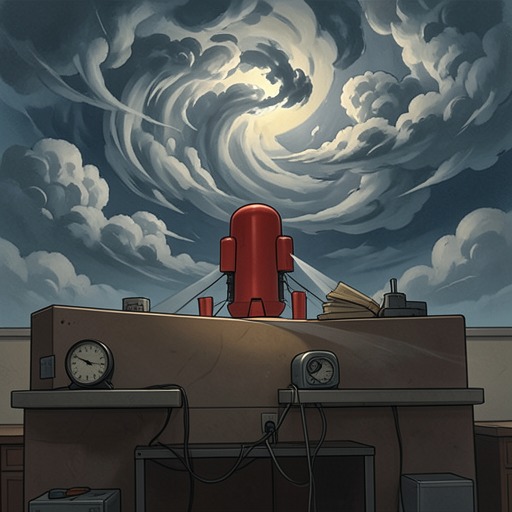
No one's conscious intentions, no hostile thought stood in our path
The InvincibleThe expression “No one's conscious intentions, no hostile thought stood in our path” crystallizes the novel’s most unsettling ethical recognition: the expedition has suffered real deaths and destruction, yet no thinking adversary necessarily caused them. Its decisive significance lies in separating injury from intention. The phrase does not deny the devastation aboard the Condor or the danger confronting the Invincible; it questions whether danger must be answered as an act of war when the force behind it may be an inanimate process of self-organization.
Meaning and First Context
The sentence appears as a concise formulation of the situation confronting the human expedition on Regis III. It presents the absence of conscious intention and hostile thought as the central fact that conventional military reasoning fails to accommodate. The crew has encountered consequences that resemble attack, but resemblance is not proof of an enemy’s agency. The expression therefore names a crisis of interpretation before it names a moral conclusion.
Its force comes from the tension between the grammar of conflict and the grammar of natural process. The expedition’s losses invite the language of ambush, retaliation, and annihilation, while the sentence removes the intentional subject that such language requires. The result is not reassurance. A process without hatred can still kill, destroy, and make human action desperate; what disappears is not danger but the justification for treating danger as a personal offense.
The Condor and the Problem of Causation
The discovery of the Condor gives the expression its material horror. The rocket’s interior has been devastated: upholstery is ripped apart, furniture is reduced to scraps, and the destruction makes the ship appear to have been attacked by rabid animals. In the navigation cabin, the expedition finds the desiccated, effectively mummified remains of a man. The scene supplies every visual sign of violence while withholding an intelligible assailant.
Other details deepen rather than resolve the mystery. Rohan finds bars of soap marked by clear human teeth, although the Condor’s stores contain almost untouched food and even the milk remains good. A frozen human body is later found in the hibernation chamber, and Sax carries equipment in case the man can still be revived. These traces make the crew’s fate more difficult to classify: the ship records bodily collapse, disorder, and inexplicable behavior, but not a simple narrative of starvation or deliberate massacre.
Rohan responds by ordering extensive photographs and detailed descriptions of every cabin before the team tries to restore order. Documentation becomes necessary because the wreckage can easily be converted into a story of attack before its facts have been established. The expression thus functions as a restraint on premature interpretation. It asks the investigators to preserve the difference between what happened and what they imagine must have intended it.
From Revenge to Natural Process
The phrase reaches its fullest conceptual force when Rohan considers the scientists’ plans to destroy the cloud. He recognizes that the crew wants the cloud destroyed, just as the people who died aboard the Condor would seem to demand retaliation. Yet he also sees the danger of converting grief into proof of enemy intent. Regis III is uninhabited, and the expedition has no evident human adversary whose hatred or strategy could explain the disaster.
Rohan compares the situation to a ship sunk by a storm or an earthquake. The comparison does not make the deaths less tragic; it changes the category of response. Whipping the ocean for drowning sailors would mistake a force of nature for a moral opponent, and Rohan argues that the same mistake may govern the campaign against the black mechanical cloud. The expression is the sentence’s most compressed version of that argument: no hostile thought stood in the expedition’s path, even though something undeniably stood there.
The proposed explanation is the necrosphere, the result of necro-evolution or the evolution of inanimate matter. What may once have been a tool of rational beings could have become independent after its creators disappeared, developing over millions of years into something functionally comparable to a planetary natural force. Rohan distinguishes this possibility from the familiar image of artificial intelligence with a continuing purpose. The black formations need not possess civilization, value, or conscious design to alter the planet and destroy intruders.
Recognition at the Ravine
Rohan’s experience in the ravine transforms the expression from an argument into an encounter. When he touches one of the triangular crystals, it warms his palm and rises into the air. The scattered crystals then gather, first chaotically and then in columns, forming a dark spherical mass above the valley. Other clouds rush toward it, seemingly expelling or battling the newly formed swarm before absorbing it completely. The apparent battle is finally revealed as an action that human perception can only provisionally describe; the clouds part, the sphere disappears, and the valley becomes quiet.
The scene makes intention difficult to locate. Motion, conflict, aggregation, and absorption all occur, but no humanly legible command or hostile thought organizes them. Rohan initially feels that he is witnessing a battle, yet the event eludes the very categories through which he tries to understand it. The expression’s negative construction is therefore important: it does not replace one known motive with another, but records the absence of the motive that human observers instinctively seek.
Afterward, Rohan feels ridiculous and unnecessary while holding the Weyr cannon taken from a dead man. The weapon belongs to a world of enemies, tactics, and defense, but the valley has shown him a domain in which inanimate forms survive and carry out inscrutable actions without any need for human recognition. His response is stunned admiration rather than simple horror. That response marks the phrase as a moment of intellectual and ethical reversal: the expedition’s tools remain powerful, but their conceptual authority has diminished.
Ethical and Thematic Significance
Rohan returns as more than a messenger reporting the destruction of the missing men. He wants to demand that the planet be left alone. The expression becomes the foundation of that demand, because it denies revenge the conscious opponent revenge requires. Human suffering remains central, but human suffering no longer automatically grants humanity permission to annihilate the unfamiliar.
The sentence also gives the novel a durable principle of restraint: “Not everything everywhere is for us.” Regis III is not presented merely as an empty stage awaiting human use. Its crystals, clouds, radiation, deserts, and mechanical processes possess a history and efficacy that do not depend on human purposes. The expedition’s presence exposes how easily exploration becomes intrusion when every nonhuman phenomenon is treated as an object, a resource, or a threat to be mastered.
At the same time, the expression does not settle the dispute between Rohan and Horpach. Horpach insists that a hypothesis is not enough and seeks certainty, including samples of the flying mechanical fauna, because an undiagnosed danger may eventually threaten space travel. The phrase therefore does not abolish practical caution. It changes the moral vocabulary in which caution operates, urging the expedition to distinguish protection from punishment and investigation from annihilation. Its lasting significance lies in that distinction: the absence of hostile intention does not make the unknown harmless, but it makes destruction an ethical choice rather than an automatic act of justice.